The Veto and the Architecture of Global Paralysis
The vote itself took less than a minute. The cruelty and disastrous human consequences of it will last for generations. That is the power of the veto. And this is what it does.
Part One: The Hand That Rose
On the morning of 18 September 2025, the fifteen members of the United Nations Security Council gathered in the chamber that has witnessed the great debates of the postwar world. The agenda was a draft resolution on Gaza: an immediate and permanent ceasefire, the release of all captives, and the unconditional lifting of Israeli restrictions on humanitarian aid. The room was heavy with the accumulated grief of nearly two years of war. The ambassadors of fourteen nations had already made their positions clear. They would vote yes.
The United States Ambassador to the United Nations, Dorothy Shea, sat at the curved table reserved for the permanent members. She had been in the post for less than a year, appointed by the second Trump administration to represent American interests at the world body. Before her appointment, Shea had served as Deputy Chief of Mission at the US Embassy in Cairo and as Chargé d'Affaires in Lebanon. She understood the region. She understood the consequences of the vote she was about to cast.
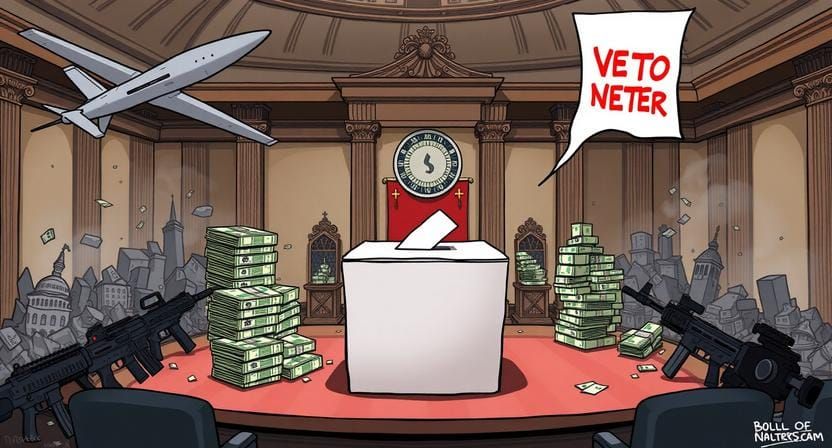
When the President of the Council called for the vote, fourteen hands rose in favour. Shea raised hers alone as against. The resolution failed.
After the vote, Shea read a statement explaining that the United States could not support a resolution that did not explicitly condemn Hamas and secure the release of American hostages still held in Gaza. She spoke of the US administration's commitment to Israel's security and the need for any ceasefire to be negotiated directly between the parties. She did not speak of the more than 65,000 people who had already been killed, among them 16,000 children. She did not speak of the famine that the UN Secretary‑General had called "a man‑made disaster, a moral indictment, and a failure of humanity itself." She did not speak of the two‑year‑old child named Ahmed, who lay in a hospital ward in Gaza City, his body wasted by malnutrition, his chances of survival diminishing with each day the humanitarian blockade continued.
The vote itself took less than a minute. The cruelty and disastrous human consequences of it will last for generations.
That is the power of the veto. And this is what it does.
Part Two: The Ashes of Geneva
To understand the veto held by the permanent five (P5) members of the UN Security Council, one must first understand the failure it was designed to prevent.
A quarter of a century prior to the inception of the United Nations, the League of Nations was established on 10 January 1920. Born from the wreckage of the First World War and the idealistic vision of American President Woodrow Wilson, its purpose was noble: to prevent future wars through collective security, disarmament, and the peaceful settlement of disputes. Its design was fatally flawed. The League's Covenant required unanimity among all member states for any substantive action. Every nation, large or small, possessed what was effectively a veto. A single dissenting vote from any one of these nations could paralyse the entire body.
The consequences were catastrophic. When Japan invaded Manchuria in 1931, the League condemned the action but could not agree on sanctions. Japan simply withdrew from the organisation. When Italy invaded Abyssinia in 1935, the League imposed limited sanctions but exempted oil—the one commodity that might have halted Mussolini's war machine. Britain and France, fearing they might drive Italy into alliance with Nazi Germany, refused to support stronger measures. The Abyssinian Emperor Haile Selassie, speaking in June 1936, warned the League's Assembly: "It is us today. It will be you tomorrow." He was right.
By 1939, the League was a ghost. It had failed to prevent the re-militarisation of the Rhineland, the annexation of Austria into Nazi Germany in March 1938, the dismemberment of Czechoslovakia, and the outbreak of World War Two. Between both world wars, over ninety million people had died. The lesson was searing: an organisation that required unanimous consent from all members could not act decisively against aggression. A different design was needed.
Franklin Roosevelt, who had served as Assistant Secretary of the Navy in Wilson's administration and had witnessed the League's failure at close hand, understood this. As early as 1941, before the United States had even entered the war, he began planning for a successor organisation. His central insight was that the new body must be grounded in realism, not idealism. It must recognise that the great powers—the nations with the military and economic strength to enforce peace—would only participate if their vital interests were protected.
The veto that was to become chartered in this new body was not an afterthought. It proved to be the cornerstone of the entire enterprise. But it was not, as is often assumed, an American invention.
Part Three: The Soviet Demand
From 25 April to 26 June 1945, delegates from fifty nations gathered in San Francisco to draft the Charter of the newly formed United Nations. The war in Europe had ended three weeks before the conference began. The war in the Pacific would continue for another three months after it concluded. The delegates worked in the shadow of the atomic bomb, tested at Alamogordo in July and deployed over Hiroshima and Nagasaki in August. The stakes could not have been higher.
The structure of the Security Council was the most contentious issue. And the most contentious element of that structure was the veto. Historical records show clearly that the veto was a Soviet demand, insisted upon by Joseph Stalin and his representatives with a ferocity that nearly derailed the entire conference.
Stalin's insistence was rooted in the trauma of the preceding decades. The Soviet Union had been invaded twice by Germany in the span of a single generation—in 1914 and again in 1941. It had lost an estimated twenty-seven million people in the Second World War, more than any other nation. It had watched the League of Nations fail to prevent the rise of Nazi Germany, and it had watched the Western powers appease Hitler at Munich. Stalin was determined that no international organisation would ever be able to compel the Soviet Union to act against its own foreign interests.
At the Yalta Conference in February 1945, Stalin made his position explicitly clear. He demanded that the permanent members of the Security Council must have the absolute right to veto any substantive action, including action against themselves. Roosevelt and Churchill were reluctant at first before becoming resigned to Stalin's insistence. They understood that without Soviet participation, the new organisation would be as toothless as the recently abandoned League of Nations. They also understood that the United States Senate, which had refused to ratify the League Covenant, would never accept an organisation that could compel American troops to fight in conflicts not of America's choosing. And so the veto, in this sense, served American interests as well.
The Soviet Foreign Minister, Vyacheslav Molotov, articulated the logic at San Francisco with characteristic bluntness. The great powers, he argued, had borne the burden of winning the war. They would bear the burden of keeping the peace. They could not be expected to do so if they could be outvoted by a coalition of smaller states. "The principle of unanimity of the great powers," Molotov declared, "is the cornerstone of the whole edifice of the United Nations." The Soviet delegation threatened to walk out if the veto was weakened. The Americans and the British, after tense negotiations, agreed to the Soviet terms.
The veto, then, was the price of Soviet participation in the new world order. It was a concession to the reality of power, extracted by the nation that had suffered most from the previous war and was determined never to suffer again. And so the veto became an explicit feature of the Charter. Demanded by Moscow and accepted by Washington and London because the alternative was no United Nations at all.
The compromise came to be known as Article 27 of the UN Charter. It provided that decisions of the Security Council on all matters other than procedure would require "the concurring votes of the permanent members." In plain English: any one of the P5 nations could single-handedly block any proposal that did not serve its interests, or the interests of its political allies. The smaller nations accepted this arrangement because they had no choice. The great powers had made clear that they would not join an organisation that could compel them to act against their will. The choice was between a flawed system, or no system at all.
Part Four: The Arithmetic of Exclusion
The consequences of this architecture extend beyond the paralysis of the Security Council in times of crisis. They shape the very composition of the United Nations itself.
To join the UN, a prospective member must be recommended by the Security Council and approved by a two-thirds vote of the General Assembly. The recommendation of the Security Council, as a substantive matter, is subject to the concurring votes of the P5 as detailed in Article 27 (3) of the Charter. Any single one permanent member can therefore prevent any nation from taking its seat among the community of states, regardless of how many other members voted to include its admission.
Palestine is recognised as a sovereign state by 164 of the 193 UN member states—more than many current UN members receive from their peers. In May 2024, the General Assembly voted overwhelmingly to support Palestine's application for full membership, with 143 votes in favour, 9 against, and 25 abstentions. Yet Palestine remains a "non-member observer state" because the United States has made clear it would veto any recommendation from the Security Council to include Palestine in support of its ally—Israel. In April 2025, the US formally exercised that veto, blocking a resolution that would have granted Palestine full membership of the UN. The explanation offered for this decision was that, in the opinion of the United States, Palestinian statehood must only emerge from direct negotiations with Israel—the very nation it is in military conflict with, and an ally of the US. The effect is that the democratic will of more than three-quarters of the world's nations is nullified by a single vote against it.
Kosovo declared independence from Serbia in 2008 and has been recognised by over 100 UN member states, including the United States and most European Union countries. It cannot join the UN because Russia and China block its admission. Russia's position reflects its broader concern about separatist movements—particularly in the Caucasus and, more recently, in eastern Ukraine. China's position reflects its insistence that Taiwan is an inalienable part of Chinese territory and that any recognition of Kosovo would set a precedent that could be invoked by advocates of Taiwanese independence.
Taiwan itself presents the most stark example. The Republic of China was a founding member of the United Nations and held China's permanent seat on the Security Council until 1971, when the General Assembly voted to transfer recognition to the People's Republic of China. Taiwan, also a founding member of the UN, was expelled from it during this time and has never been readmitted. Any application for membership would be vetoed by China, which maintains that Taiwan is not a separate sovereign entity but a province of China. The 23 million people of Taiwan have no representation at the United Nations.
Each of these vetoes is justified by each of these nations based upon the national and political interests of its own government. The United States defends its alliance with Israel. Russia defends its strategic interest in preventing precedents for secession. China defends its claim to territorial integrity. Yet each also violates the universalist principles the UN claims to embody: sovereign equality, universal membership, and the right of peoples to self-determination.
Part Five: The Data That Bleeds
The veto is a mechanism that has measurable consequences. To understand these, one must look at not only the number of vetoes cast, but what those vetoes enabled and allowed to happen through inaction of failed resolutions.
Since the founding of the United Nations, the veto has been exercised over three hundred times. The distribution among the permanent members is revealing. As of May 2022, Russia (and previously the Soviet Union) had cast 121 vetoes, the United States 82, the United Kingdom 29, China 17, and France 16.
These numbers have continued to rise: in 2024, permanent members cast eight vetoes, the highest number since 1986. And in 2025, the Council adopted only 44 resolutions, the lowest number since 1991. But these figures do not tell the story about the people who died while the Council was gridlocked.
Consider Gaza. Between October 2023 and September 2025, the United States vetoed eight Security Council resolutions calling for a ceasefire in the Israel-Gaza war. Each veto shielded a specific policy from international censure: the continuation of military operations that, over the same period, killed more than 65,000 people, including 16,000 children. Each veto allowed the blockade to continue, preventing food, water, and medicine from reaching a population on the brink of famine. The UN Secretary‑General described the famine in Gaza City, affecting more than 500,000 people, as "a man‑made disaster, a moral indictment, and a failure of humanity itself."
Consider Ukraine. Since Russia launched its full-scale invasion in February 2022, the Security Council has been unable to take any meaningful action because Russia itself wields the veto. Resolutions condemning the invasion, calling for the withdrawal of Russian forces, and demanding accountability for war crimes have all been blocked. On 4 April 2026, Russia vetoed a Western-backed resolution condemning its annexation of Ukrainian territory. The vote was 10 in favour, 1 against, and 4 abstentions. The resolution failed. The war continues, with hundreds of thousands of casualties and millions displaced. Russia's veto has enabled its military campaign and the largest land war in Europe since 1945.
Consider Syria. Since the conflict began in 2011, Russia has exercised its veto 13 times to protect the regime of Bashar al-Assad from Security Council action until his eventual overthrow in 2024. China had joined Russia in vetoing resolutions on Syria on at least six occasions. These vetoes enabled a specific military campaign: the brutal suppression of a popular uprising that has killed hundreds of thousands of Syrians and displaced half the country's pre-war population. In one notable instance, Russia and China vetoed a resolution calling for a seven-day ceasefire in Aleppo to allow the delivery of humanitarian aid. The UK representative at the time, Matthew Rycroft, told the Council that by vetoing the resolution, Russia and China "have also held to ransom the lives of hundreds of thousands of innocent men, women and children currently enduring hell in Aleppo."
Consider Myanmar. Following the military coup of February 2021, the Security Council attempted to respond to the violent crackdown on pro-democracy protesters. China and Russia have repeatedly blocked or watered down resolutions that would have imposed sanctions or an arms embargo on the junta. Their vetoes have protected a specific regime—one that has killed thousands of its own citizens and driven hundreds of thousands more into exile.
The pattern is consistent. The veto is not used randomly or ideologically. It is used to protect specific interests, shield specific allies, and enable specific policies. Each veto has a name attached to it—the name of the ambassador who raised their hand against the resolution. Each veto has a consequence—the bombs that continued to fall, the children who continued to starve, the families who continued to flee.
Part Six: The Question of Reform
The case for reform is straightforward. Since the UN was established, the number of member states has quadrupled from 51 to 193. The global population has grown from 2.5 billion to over 8 billion. Entire continents—Africa, Latin America—have no permanent representation on the Security Council. The Council's composition reflects the geopolitical realities of 1945, not 2026.
Reform proposals have circulated for decades. The African Union, through the Ezulwini Consensus, has advanced the clearest demand: an expansion of the Council to 26 members, with Africa holding two permanent seats with full veto rights and five non-permanent seats. The G4 nations—Brazil, Germany, India, and Japan—have proposed expansion to 25 or 26 members, with six new permanent seats: two for Africa, two for Asia and the Pacific, one for Latin America and the Caribbean, and one for Western Europe. Under the G4 proposal, new permanent members would gain veto powers after a review period of ten to fifteen years.
More modest proposals focus on limiting the use of the veto rather than expanding it. In March 2026, fourteen countries led by Mexico and Spain signed a formal letter calling for stricter implementation of Article 27 (3) of the Charter, which requires parties to a dispute to abstain from voting. The signatories—including Austria, Bulgaria, Estonia, Kuwait, Liechtenstein, Luxembourg, Mexico, Norway, Slovenia, Spain, Sweden, Switzerland, and East Timor—argued that enforcing the mandatory abstention clause could be an effective step towards restoring impartiality to the Council.
The Liechtenstein-led "veto initiative," adopted by the General Assembly on 26 April 2022, represents the most significant reform to date. Under Resolution 76/262, the President of the General Assembly must convene a formal meeting within ten working days whenever a veto is cast in the Security Council. The vetoing state is required to explain its action before the full membership of the UN. The initiative does not eliminate the veto, but it imposes a measure of accountability and transparency. It forces the veto-holder to defend its decision in public, before the representatives of 193 nations.
France has proposed a voluntary code of conduct under which the permanent members would refrain from using the veto in cases of mass atrocities—genocide, crimes against humanity, and war crimes. The proposal has been endorsed by Mexico and a number of other states, but has not been adopted by the other permanent members. The United States, Russia, and China have shown no interest.
More radical proposals have been advanced. Slovenian President Nataša Pirc Musar has called for the abolition of the absolute veto power, proposing instead that vetoes could be overridden by a super-majority of the General Assembly or by a qualified majority within the Security Council itself. Ukrainian President Volodymyr Zelensky, addressing the Security Council in September 2025, called for Russia to be stripped of its veto power entirely, arguing that "veto power in the hands of the aggressor is what has pushed the UN into a deadlock."
The obstacle to all these proposals is the same: Charter amendment requires the consent of all five permanent members. The veto-holders must agree to curtail their own power. Russia will not surrender its veto while it faces condemnation for its invasion of Ukraine. China will not surrender its veto while it faces scrutiny over Taiwan, Xinjiang, and the South China Sea. The United States will not surrender its veto while it shields Israel from diplomatic pressure. The United Kingdom and France, the two European permanent members, have shown some openness to modest reforms, but neither has advocated for the elimination of the veto itself.
The paradox of reform is that it requires the consent of those who benefit most from the current status quo.
Part Seven: A Judgement
The arguments for the veto are not frivolous. The founders of the UN were right to fear that an organisation that could compel the great powers to act against their will would be abandoned by those powers, just as the League had been abandoned. The veto was the price of great-power participation. For eighty years, it has arguably succeeded in its narrowest purpose: there has been no third world war. The nuclear powers have not gone to war with one another.
But the price of that success has been staggering. The veto has shielded aggressors from accountability. It has enabled the commission of atrocities. It has paralysed the one institution capable of responding to the most urgent threats to international peace and security. It has condemned millions of people—in Gaza, in Ukraine, in Syria, in Myanmar, and in a dozen other crises—to suffer and die while the Council debates resolutions that are doomed from the moment they are tabled.
The veto, as currently constituted, is not a mechanism for maintaining peace. It is a mechanism for maintaining power. It serves the interests of the five permanent members, not the interests of the 188 other nations that have no such privilege. It is a relic of 1945, preserved by the self-interest of those who wield it, long after the geopolitical conditions that produced it have vanished.
What, then, is to be done?
Abolition is impossible. Charter amendment requires the consent of the veto-holders, and they will not consent to their own diminishment. But abolition is not the only path.
The French proposal—a voluntary code of conduct under which the P5 would refrain from using the veto in cases of mass atrocities—should be pursued with renewed vigour. It does not require a Charter amendment. It requires only political will. The United Kingdom and France have already signalled their support. Pressure should be brought to bear on the United States, Russia, and China to join them.
The Liechtenstein initiative should be strengthened. The requirement that veto-holders explain their actions before the General Assembly is a modest but meaningful constraint. It forces accountability. It forces transparency. It forces the ambassador who raised their hand to look the representatives of 193 nations in the eye and justify what they have done.
The Uniting for Peace resolution, adopted in 1950 to circumvent Soviet vetoes during the Korean War, should be used more frequently and more boldly. When the Security Council is gridlocked, the General Assembly must act. General Assembly resolutions are not legally binding, but they carry the moral weight of the world's nations. They can authorise sanctions. They can establish tribunals. They can deploy peacekeeping forces. They can do much of what the Security Council can do, if the political will exists.
Finally, the campaign for an African permanent seat must continue. It is an injustice that a continent of 1.4 billion people has no permanent representation on the Council. The African Union's demand is just. It should be supported, not with vague expressions of sympathy, but with concrete diplomatic action.
These reforms will not eliminate the veto. They will not erase the injustice of a system that gives five nations the power to bind the entire world. But they will constrain the veto. They will make it more costly to use. They will chip away at the edifice of privilege that the permanent members have constructed around themselves.
The veto was born from the ashes of the League of Nations, a deliberate response to the catastrophic failure of an earlier experiment in collective security. It was demanded by Stalin, accepted by Roosevelt and Churchill, and inscribed in the Charter as the price of great-power participation. It has succeeded in its narrowest purpose: there has been no third world war. But it has failed in its broader purpose: to maintain international peace and security. It has become a mechanism for enabling paralysis, shielding aggression, and protecting the powerful at the expense of the vulnerable.
The two-year-old child in Gaza, the displaced family in Idlib, the villagers in eastern Ukraine whose homes have been destroyed by shelling—they cannot wait for the slow grinding of geopolitical tectonic plates. They need protection now. And the institution created to provide that protection stands paralysed, its hands bound by a rule written eighty years ago.
The single hand that rose in opposition in the Security Council chamber on 18 September 2025 is not the hand of one ambassador, nor of one nation. It is the hand of all of us—every government that has accepted this arrangement, every institution that has declined to challenge it, every citizen who has looked away. We have permitted a system in which one voice can silence the moral will of the world.
It is no longer debatable whether the single veto of any one of the permanent five Security Council members will continue to produce suffering. It will. The cold, unassailable precision of those who have done the work, who have counted the dead, demonstrates it. The question we have evaded, at the cost of countless lives, is whether we will finally summon the courage to strip the Council of its power to overrule the conscience of humanity itself.